

In mid-November, I attended the launch of the second, revised edition of Angéla Murinai’s book Mother’s Heart/Mother Struggles [a Hungarian wordplay of “szív” meaning both “heart” and “suck” as in e.g., getting the short end (of parenthood)]. As the first edition was impossible to obtain in shops, I was eager to buy this one while also meeting the author.
I asked her what she found most challenging in raising children and who she got support from. She answered that she often felt lonely and left alone with the problems and decisions regarding her kids. Just like her, many women feel the same way: ‘I love my children, but I hate motherhood’.
Why do we give birth in this world? The answers are varied, and one of Angéla’s primary research projects concerns this very question. The mothers surveyed were able to choose among responses such as:
- ‘It’s the way of life; you get married and have children’
- ‘All my life I wanted to be a mother’
- ‘I thought I would miss out on something very important in life without a child’
- ‘I wondered what it would be like to be a mother, what it would be like to have a new person coming out of my body’
- ‘It just happened; I became pregnant and we kept it’
- ‘My partner wanted it more; I gave in’
- ‘I had no idea what I could do without a child’
- ‘I knew my family expects it’.
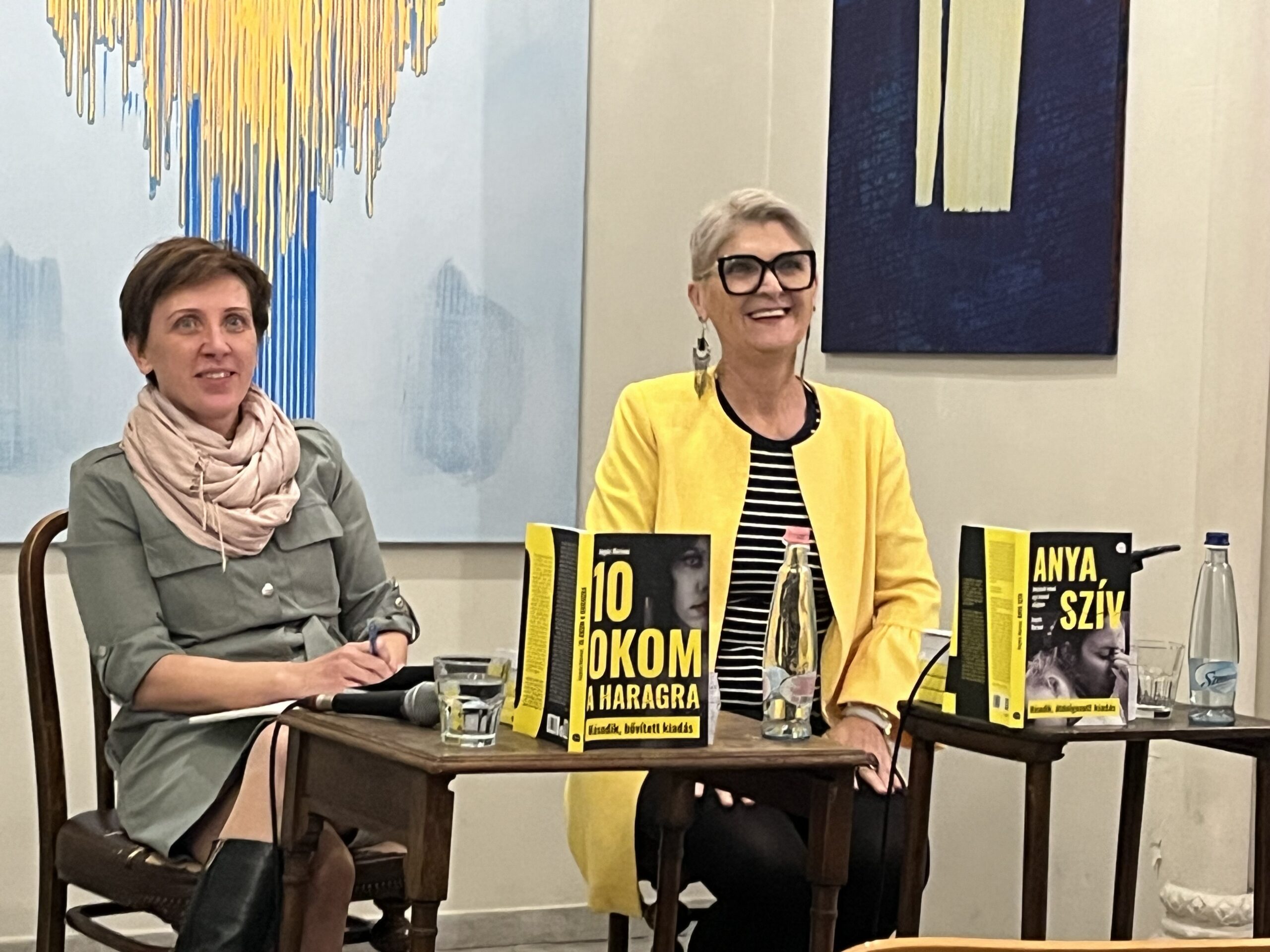
For some time now, Angéla Murinai has not only known but also has been raising awareness that the abandonment and vulnerability of mothers is a systemic problem, generated and fuelled by the patriarchal system. Back in the day, witch-hunts also targeted, among others, women who did not give birth, because at that time it was the vocation of every “decent woman” to bring offspring into the world.
In Western societies, a feminist turn occurred in the 1980s and 1990s. Although women have taken on more work outside the home (alongside “invisible unpaid labour”), their vulnerable status and dependence on men (their husbands, or partners) have unfortunately not decreased in proportion. The need for women’s employment keeps growing, especially because ‘having children has always been an expensive hobby, but nowadays counts as a luxury.’
Honestly talking about our difficulties (expressing negative feelings such as anger and frustration), breaking taboos about motherhood, and challenging false myths can already help lift emotional burdens. Since most of the time, no one, not even our mothers, can openly tell us what difficulties we will face if we decide to have children. When we embark on it, we think that motherhood will be just a slice of the cake of our lives, only to find out that this role is the cake itself. However, ideally,
Motherhood does not need to be an Identity. It is enough to be an important part of our lives.
The book has several virtues. Firstly, it contains many deep, personal stories from women – the author herself opens up and reveals, among other things, that she smoked a lot in harder phases and at times she even slipped into consuming alcohol.
The book also includes questions and results from several of her own surveys, for instance, on how much women got out of motherhood compared to what they originally expected. Important topics such as suffocating guilt, intensive parenting, abusive children, a narcissistic and passive-aggressive mother, burnout in motherhood, addictions, the roles of the mother-in-law and grandparents are also covered.
At the end of the book, a few suggestions for “survival” are included. Just to mention a few:
- becoming financially independent
- choosing a good partner (see in your partner who he or she could become next to you)
- developing self-awareness (don’t have a baby out of therapeutic desire)
- listening to other people’s experiences and stories (you might even learn from them).
This book is not only recommended to those who do not have children yet (for them, very much!), but also to those who are already mothers. Solidarity and comfort are provided for them by knowing that it is not necessary or even possible to be a perfect mother. It is alright to be a ‘good enough’ mother.
Angéla, who originally worked as a teacher, had three sons, one of whom she lost in tragic circumstances in Malta. Shortly afterwards, her husband died. After the many hardships, she emigrated to Germany a few years ago and still lives there with her two sons. It is a fertile period in her writing career.
Translated by Zsuzsa Petrás
